

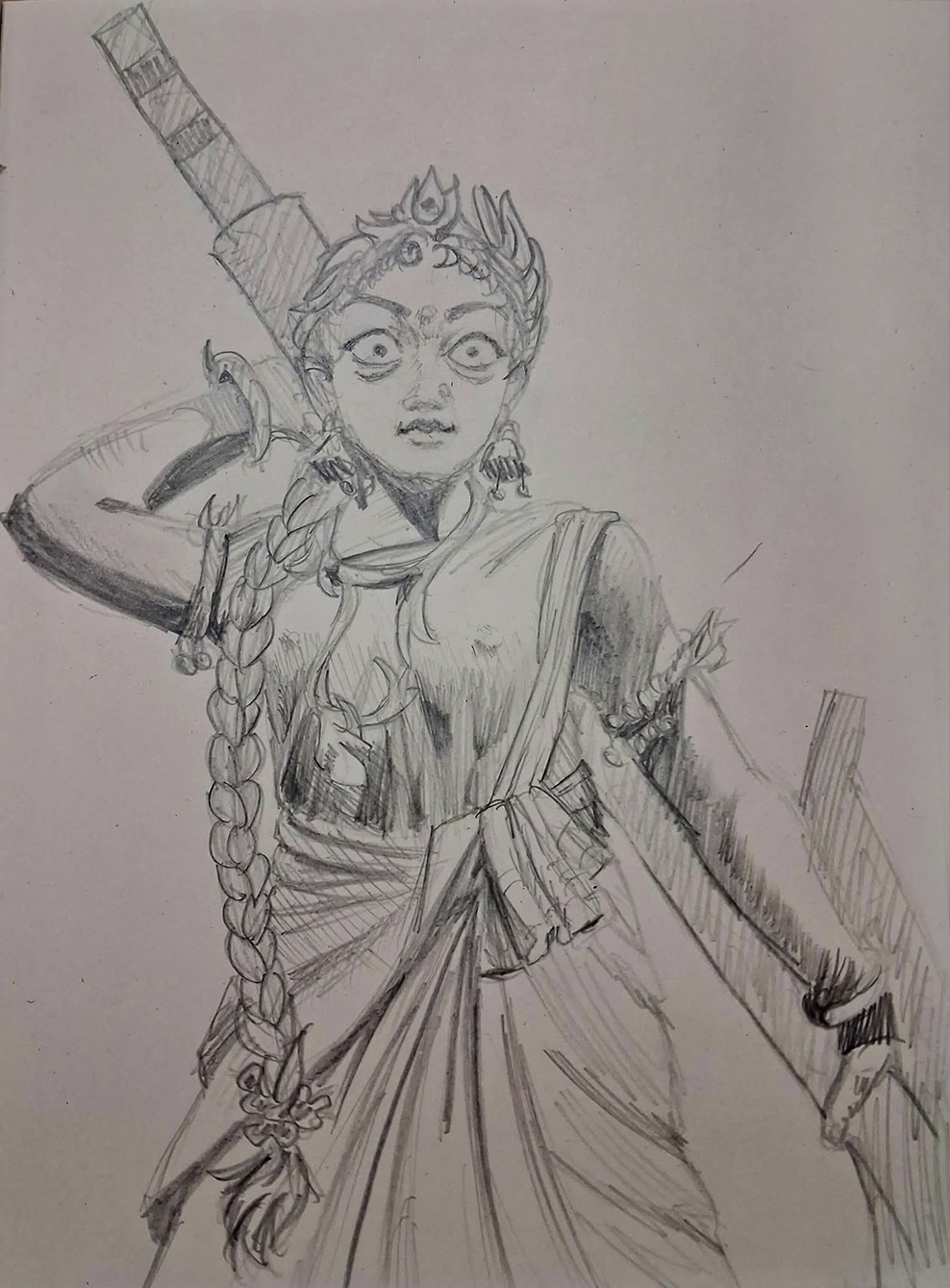
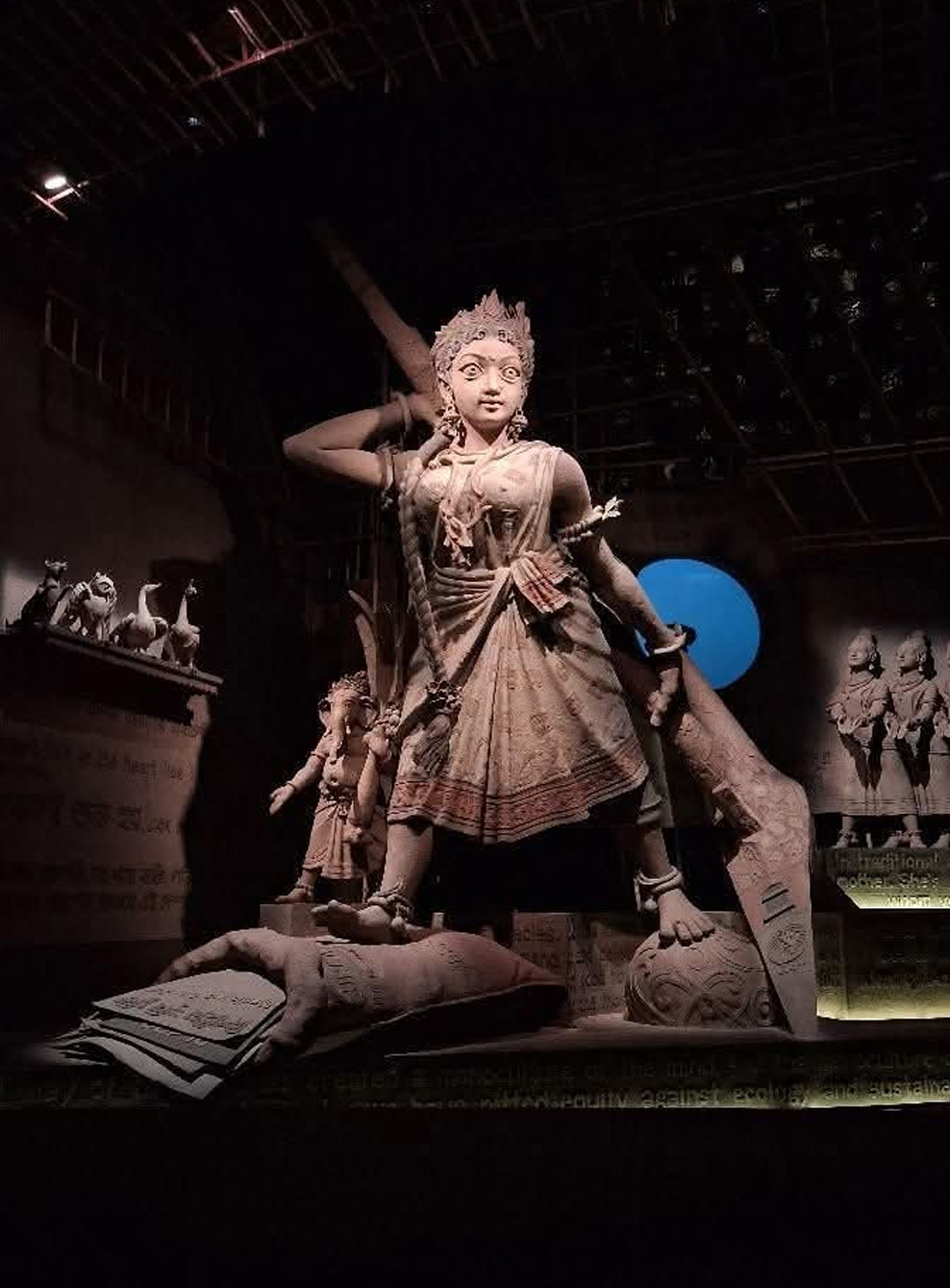
Standing 25 feet tall, with a high ceiling above her head and a huge open space in front of her, she allows the visitor to see her exactly as a sculpture should be seen – walking around it. Most will however get to see her from a raised platform, at a little distance, where her torso will be at their eye-level. She is a martial figure – but of agrarian labour – carrying the most important farming tool, the plough, on her shoulder. Frozen in motion, she walks with purpose, intent on destroying anything that comes in the way of her onward march – trampling all that is redundant and harmful under her feet. Her printed saree is hitched high, with the aanchal tied firmly round the waist and a bit tucked in; how else can one work in the field? She is sturdy – exuding health in her well-rounded limbs, adorned with bands and anklets. Her voluptuous breasts thrust out, with the nipples visible through the folds of her rough fabric. A laurel shapes into a crown on her head; an uneven garland of twigs hang from her neck and flowers are tied at the end of her long braid touching her knee. She is of the soil and emerges from a vegetal landscape. The only decorative piece of jewellery on her is a pair of jhumkas that frame her beautiful face. It is a beauty that inspires awe and strikes terror at the same time. The eyes are its defining feature, rage shooting out of them like arrows at invisible targets. But that fierceness is tempered by the soft curve of her sensuous lips and her perfectly arched eyebrows.
This colossal figure of Ma Durga at Tala Prattoy, by Bhabatosh Sutar, can make a worshipper of any godless mortal by the sheer power of her presence. Being in front of her is a visceral experience: one’s jaw drops; hands fly to the heart or hold an arm nearby, just to absorb the shock of this terrible beauty! Everything else pales before her; everyone else is consigned to small corners of a huge hemisphere of light and shadow. Three of her children – Lakshmi, Saraswati and Kartik – form a cluster at a distance on her left, almost indistinguishable from each other; and all the bahons earn a place on a shelf on her right. Only Ganesh strides beside his mother, keeping close to her, kola-gachh in hand.
I spent several hours this evening in front of this goddess, unable to tear myself away from her magnetic attraction. Colossal figures – both in life and art – stupefy and stun us into silence. So did this idol. I was speechless in her presence; I could only feel her aura. The aura is a feat of architectural engineering: iron and bamboo and soil came together, in unimaginably precise proportions -- to structure, layer and fill out a towering figure, roughly modelled on some domestic staff. I heard a little about the process of that transformation from the artist himself.
I found words only after reaching home; and while revisiting the images on a cold screen, it occurred to me that, in this figure, RamkinkarBaij met Sudarshan Pattanaik. In particular, she is reminiscent of the robust female figures in the former’s ‘Mill Call’ and the faces of deities that emerge out of the beach in the latter’s sand sculptures. She reminded me of the iconic ‘Mother India’ film poster of Mehboob Khan's classic, too – for the way in which she holds the plough diagonally across her shoulder, though her right arm is held down behind her back and not upwards in front. She is however beyond endurance and resilience; she is fury personified. She is also more the labourer than the mother here; her children come second to the land she has to plough and till and coax into abundance. This is only to be expected in a Durga Puja pavilion which has a seed-arena as its theme (Beej Angan), to emphasize the foundational importance of the seed in our ecosystem.
This furious farmer of a goddess kept me sleepless all night!
PS:
Though embarrasing, I temporarily broke my Facebook fast just for this piece. Couldn't save it for a later time:)
I dedicate this post to Tapati di, to whom I owe my belated interest in Durga Puja art. It happens to be her Birthday today. And I couldn't help sharing the sketch of the goddess by someone who was even more mesmerized by her than her mother!