

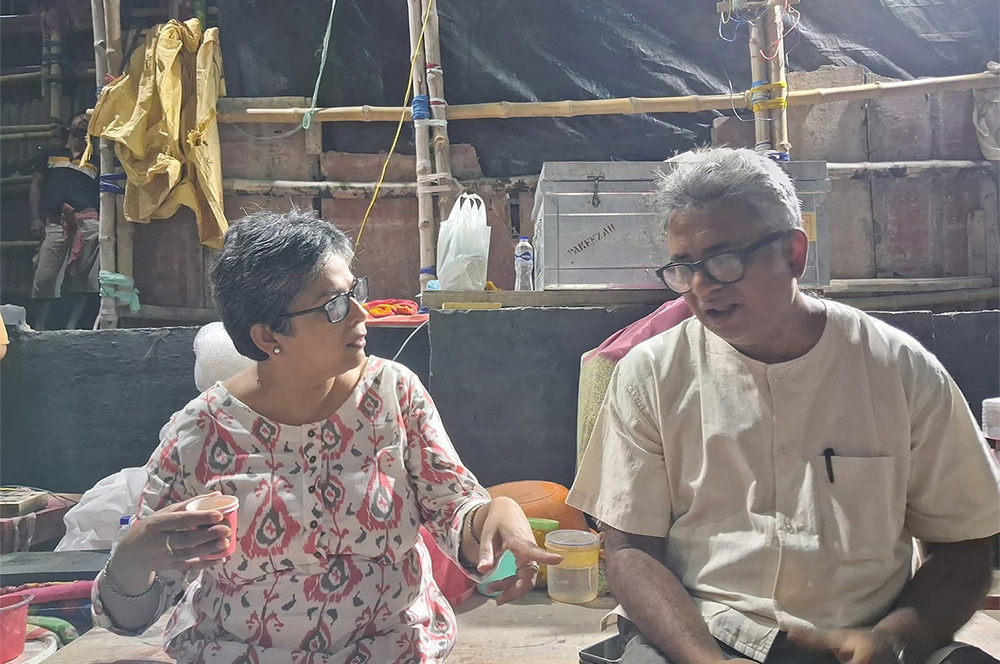
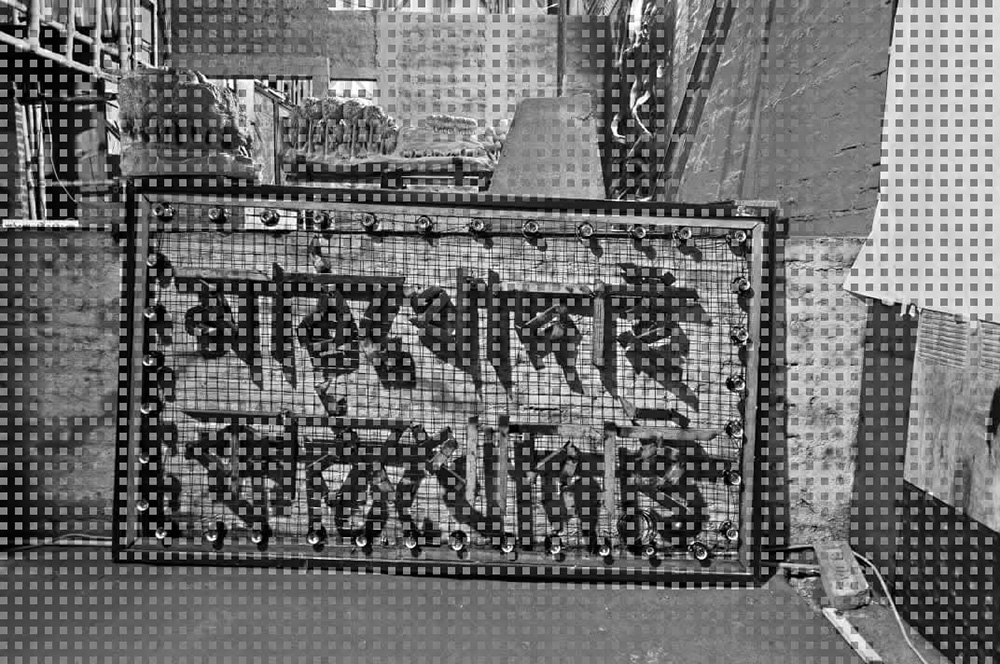
I paid a surprise visit to Purbachal Shakti Sangha (PSS) on the 8th and was treated to that rare thing: a personalized walk through of a work-in-progress pandal by Partha Dasgupta!
The artist is no stranger to my interest in 'process'; I'd visited the same venue several times in a span of five weeks in the autumn of 2023, to witness and capture first-hand the making of a Durga Puja pavilion, as it was mounted bit by bit. It resulted in a feature that was published in GetBengal on 'Shasti' that year.
Last year was a miss, which is why my curiosity has doubled in this. The theme for 2025 is “মাঠখোদাই, কাঠখোদাই” (Digging Fields, Carving Wood). খোদাই refers to the act of digging/excavating/carving – of both human labour and laborious processes involved in the act of creation. The carving of wood in the title is a reference to the process of woodcut printing, where images are carved in reverse onto a wooden block, the surface inked and then printed by pressing paper onto the block. Woodcut prints are a major component of the PSS pavilion this year; and unobtrusively woven into its overall design is a tribute to Haren Das, a pioneering printmaker of 20th century Bengal, known for recreating the landscapes of his native Dinajpur in his woodcuts – highlighting both its rural beauty and rural labour. Durga Puja is vitally connected with a harvest season; the rural labour of harvest is thus integrally bound with it. But the মাঠ or field of the theme is also the open ground in urban spaces where the goddess is now displayed and worshipped, prepared months in advance for her arrival, and ultimately merges prayer and practice in the culminating days of the festival.
Like every year, in any pavilion where Partha da has been in charge (this is his third year at PSS, he worked in many others before that), the execution of the theme is layered and nuanced, whose aesthetics can be better appreciated with a knowledge of the history of art - and its contemporary practice - in Bengal, but whose visual appeal crosses all boundaries to easily touch the uninformed audience.
What I found most notable this year, though – more than the architectural design of the pavilion and the idol of the goddess (currently hidden behind a curtain) – was the curation of art and the mentorship that powered the teamwork.
'Math Khodai, Kath Khodai' is, in a way, a “group show”, that brings together the work of six contemporary artists whose practices organically merge with the theme of the pavilion.
Bringing artists together is actually not new to Partha da's style of functioning, or in fact, to the kind of Durga Puja installation art that was ushered in post-millennial years. Where the 2025 PSS pavilion is distinct, however, is the conscious mentoring of young artists in the team.
The artist as mentor:
This turn to conscious mentoring actually started in 2018, when three students from the Government College of Art interned with Partha da, following official letters to their institution. He took this step because he wanted this kind of field experience in Durga Pujo art to gain official recognition in institutional circles.
By then, Durga Pujo art in Kolkata had already evolved with a particular trajectory of its own: beginning in the hands of traditional artists, it gradually attracted trained artists with degrees, especially from 2001. (Their numbers have continued to increase). Initially, trained artists would typically work with craftsmen; then junior artists became assistants to the main artists in the pandals.
At PSS, in 2023, this scenario changed a bit more when art historian Debdutta Gupta and Partha da inducted four artists whose work aligned with their pandal theme that year. In effect, what this meant was that, instead of assistants working with main artists, practicing artists brought their distinct styles to the pandal. They didn’t work according to the dictates of the designer; instead, their signature styles helped expand the scope of Pujo art. A new conversation began between the Pujo pandal and the artist’s studio. Partho da now assumed the role of curator. And the club somewhat took on the role of an academic institution in directly supporting the independent practices of the artists. The artists displayed their work, interacted with a huge audience who usually didn’t visit galleries, and at the end of the Pujo took their work to display in galleries in other regions of India. That way, there was a value addition to their artworks.
This year, as already mentioned, six artists will display their work at PSS. They are -- Tanmay Chakraborty (printmaking), Asish Ghosh (senior) (sculpture), Sourav Bandopadhyay (painting), Milton Bhattacharya (printmaking), Sayandeep Kanghabanik (painting), and Bijoy Choudhury (photography). Along with them, two fresh MFA students from Kala Bhavan have been given scholarships. Partha da chose them after seeing their art as an external examiner at their student Exhibition this summer. His decision was finalized after deliberating with his chief researcher, art historian Debdutta Gupta and the Club, and official letters sent to the selected candidates. They will be displaying some of their artworks which have an organic connection with the PSS theme this year.
This is a new direction in the tradition of Durga Puja art. The beauty of it is that it allows artists to continue their practice in their studios as usual, while making this platform one of the ways in which the scope of their application gets expanded.
PSS has also given rise to a new model of support to young artists, with a symbiotic relationship between a senior/acclaimed artist and a cultural club – where the artist takes the initiative to introduce/induct fresh talent from art institutions, the club funds them and the artist gives studio facility to them.
Partha da is one of the most revered artists in the Durga Puja circuit, with many awards to his credit. But it is in the self-appointed role of the artist as mentor - a role that he has been playing with increasing commitment in the last few years - that I came to admire him the most, this time. To me, it's more significant than the shift in his other role as curator.
PS:
I'm delighted that one of the Kala Bhavan students working with Partha da - Rahul Sarkar - is a young talent I was hugely impressed by while visiting Santiniketan (and accidentally, the student Exhibition) this summer. I wrote an exclusive post on him soon after my trip and I'm so glad that, thanks to Partha da, his work will find a large audience this Pujo!
A big THANK YOU to Partha da for his detailed input on my initial draft last week. He practically texted back an essay, in response to a query of mine -- written at lightning speed, with almost proof-copy perfection. I've mostly summarized that in the second section of this piece.
I also thank him for the generosity with which he shared with me a whole bunch of photos for a Facebook post!
(All of them have been taken by Agnibha Chowdhury).